Chaka is Quechua for bridge. Chakana is the thing that bridges — the crossing, the passage from one side to the other.
Chaka is Quechua for bridge. Chakana is the thing that bridges — the crossing, the passage from one side to the other.
That is not a meaning added later by someone selling something. It is what the word means, in a language spoken today by millions of people across Peru, Bolivia and Ecuador. Nearly everything else about this symbol is argued over. The bridge is not.
The shape is older than the Inca
The stepped cross did not begin with the Inca. It was already ancient when they inherited it.
It appears in Chavín work around 800 BCE, on the Tello Obelisk. It runs through Wari and Chancay material. It is everywhere at Tiwanaku, the civilisation on the shores of Lake Titicaca that rose and fell between roughly 400 and 1000 CE — centuries before the empire most people credit it to. The oldest complete example found so far comes from a temple complex at Huaral thought to be around four thousand years old.
The archaeologist Alan Kolata called it one of the most ubiquitous, if least understood elements in Tiwanaku iconography. Both halves of that are worth sitting with. Everywhere, and not understood.
One of the more grounded readings comes from the anthropologist Scott C. Smith, who suggests the stepped form may be a view from directly above of the terraced platform mounds the Andean peoples built — a temple as the sky sees it. A building, drawn from the point of view of the gods.
Why the same shape appears all over the world
This shape is not only Andean, and the true explanation is better than the one usually told.
The stepped fret appears in Mesoamerica as the xicalcoliuhqui — Nahuatl for twisted gourd — on shields, masks, ceramics, murals and textiles, read variously as water, waves, clouds, lightning, serpents and the turning of cycles. It appears in Greece as the meander, named for the winding Maeander river. It appears in China in forms that predate any contact with Greece. It appears on paleolithic bone from Ukraine carved around 23,000 BCE.
The tempting story is that one lost civilisation taught it to everyone else. The duller and far more beautiful truth is that people everywhere arrived at it on their own — and there is a reason they did.
It is the geometry of making. Weave on a loom and you cannot draw a smooth diagonal: warp and weft meet at right angles, so a slope has to be built as a staircase. Lay stone in courses and the same thing happens. Build a terrace on a mountainside and the mountain itself becomes a flight of steps. Anyone who weaves, stacks or farms a slope will produce this shape, because it is what a diagonal looks like when the world is made of squares.
So the Chakana is not a borrowed symbol. It is what human hands make when they work with thread and stone — which is why it feels familiar to almost everyone, and why it belongs on cloth more honestly than on anything else.
The three worlds, and a word that means both space and time
Pacha is one of the great words. It means place, land, soil, region, era, totality — space and time at once, inseparable. There is no Andean word that splits where from when. Scholars translate it as something like world-moment.
And the pacha is three:
- - Hanan Pacha — the world above. The celestial realm.
- - Kay Pacha — this pacha. The world we walk, with the animals and the plants and each other.
- - Uku Pacha — the inner world. Below and within: darkness, the dead, the seed, fertility, the moon.
Not a hierarchy of good and bad — that ranking arrived later, with Christian theology. Three rooms of one house. And the Chakana, the bridge, is what runs between them.
One honest note, because I would rather you hear it from me: the familiar pairing of condor, puma and serpent with those three worlds is a modern association. It is lovely and it is widely repeated, but it is not documented in pre-Columbian or colonial sources. The three worlds are old. The three animals, as a neat set, are recent.
The numbers
The Andes count in threes and fours, and the Chakana holds both.
Three is the pacha — above, here, within. It is also the shape of the oldest surviving Andean moral law, three prohibitions still taught today: ama suwa, ama llulla, ama qilla — do not steal, do not lie, do not be idle.
Four is the directions, and the empire itself: Tawantinsuyu, from tawa, four — the four regions joined. The cross arms point to them.
Two runs underneath both. Andean thought is built on pairing: yanantin, the complementary opposite, the idea that a thing is complete only with its counterpart — and ayni, reciprocity, the obligation that what is given must return. Nothing in this cosmology stands alone. Not the worlds, not the directions, not people.
The twelve corners, the months, the link to the Southern Cross constellation: treat these more carefully. The art historian Jessica Joyce Christie describes those specific readings as speculative and unsupported by historical sources. Much of that layer was assembled in the twentieth century.
I am not telling you this to take anything away. Meaning that is alive is still meaning, and the people who hold it never stopped living beside the stone. But a thing is stronger when you know which part of it is four thousand years old and which part is a hundred.
The names
This is the part I most wanted to write, because these are not concepts. They are names, and people still say them.
- - Pachamama — pacha and mama: mother of space-time. Not Mother Earth in the soft greeting-card sense, but the generating principle of the whole world-moment.
- - Apu — lord. The spirit of a mountain, and in some tellings the mountain itself. The tallest peaks hold the strongest. She has other names depending where you stand: wamani in Ayacucho, awkillu in Huánuco, achachila and mallku in Bolivia.
- - Mama Qucha — mother of the waters, from qucha: lake or sea. Written Mamacocha in the older Spanish spelling.
- - Inti — the sun. Mama Killa — the moon. Illapa — thunder and lightning, who carries the rain.
- - And the plain words for the elements: wayra, wind. Nina, fire. Yaku, water. Allpa, earth.
A note on spelling: Quechua was written down by Spanish scribes before it had its own standard orthography, so you will meet qucha and cocha, killa and quilla, suwa and sua. None is wrong. I use the modern forms here.
None of this is in a museum
The reason I can write any of it is that it is still being done.
Offerings to Pachamama — the challa, the pago — happen through August and on the first Friday of each month: chicha poured into the ground, coca leaves, food buried for her. Walk a mountain pass and you will find an apachetta, a pile of stones left by everyone who passed before you, each one a small thing given to the Apu for safe crossing. Coca leaves are blown to carry a prayer upward.
Most of the people doing this are also Catholic. Both things are true at once, and nobody there finds that strange.
Where I learned this
I should say plainly where this comes from, because it is not a reading list.
I grew up around people who live close to this. Not scholars and not performers — people for whom it is simply how the day works. What I know I learned from being there for the ordinary things: making an offering. Chewing coca. Sitting by a fire and talking until late. Helping with the potato harvest, hands in the dirt, with the mountain right there above us the whole time.
None of that was taught to me as doctrine. Nobody sat me down. It was in what people did before they ate, and what they said when the weather turned, and where they looked when they thanked something. I grew up in a world where the invisible is still present — not as a belief anyone argues for, but as something remembered and respected, built into how you move through a day. A spiritual world, held without any fuss at all.
That is my source. It is why I can tell you which parts of the popular story are recent inventions without feeling I am taking anything away — because the part that matters was never in a book I could be wrong about. It was in a kitchen, and on a mountain road, and in a field of potatoes.
What I owe the people who taught me is accuracy. So where I know, I have said so. Where the record is thin or modern, I have said that too. Both are a form of respect.
Why I built a collection on it
I grew up beside this. Not in a museum — in a blanket, in a doorway, in the shape of a window, in what people did on a mountain road.
When I started designing, I kept returning to the same idea: that what is most worth making right now is a connection. The world feels split — between countries, between people, between who we were a few years ago and who we are now. Latin America, where I grew up, is a place of staggering depth holding knowledge that survived every attempt to erase it, and many of its people are living through a hard time. I wanted to make something that said: I have not forgotten, and I am still here on the other side of the bridge.
The Chakana was already that.
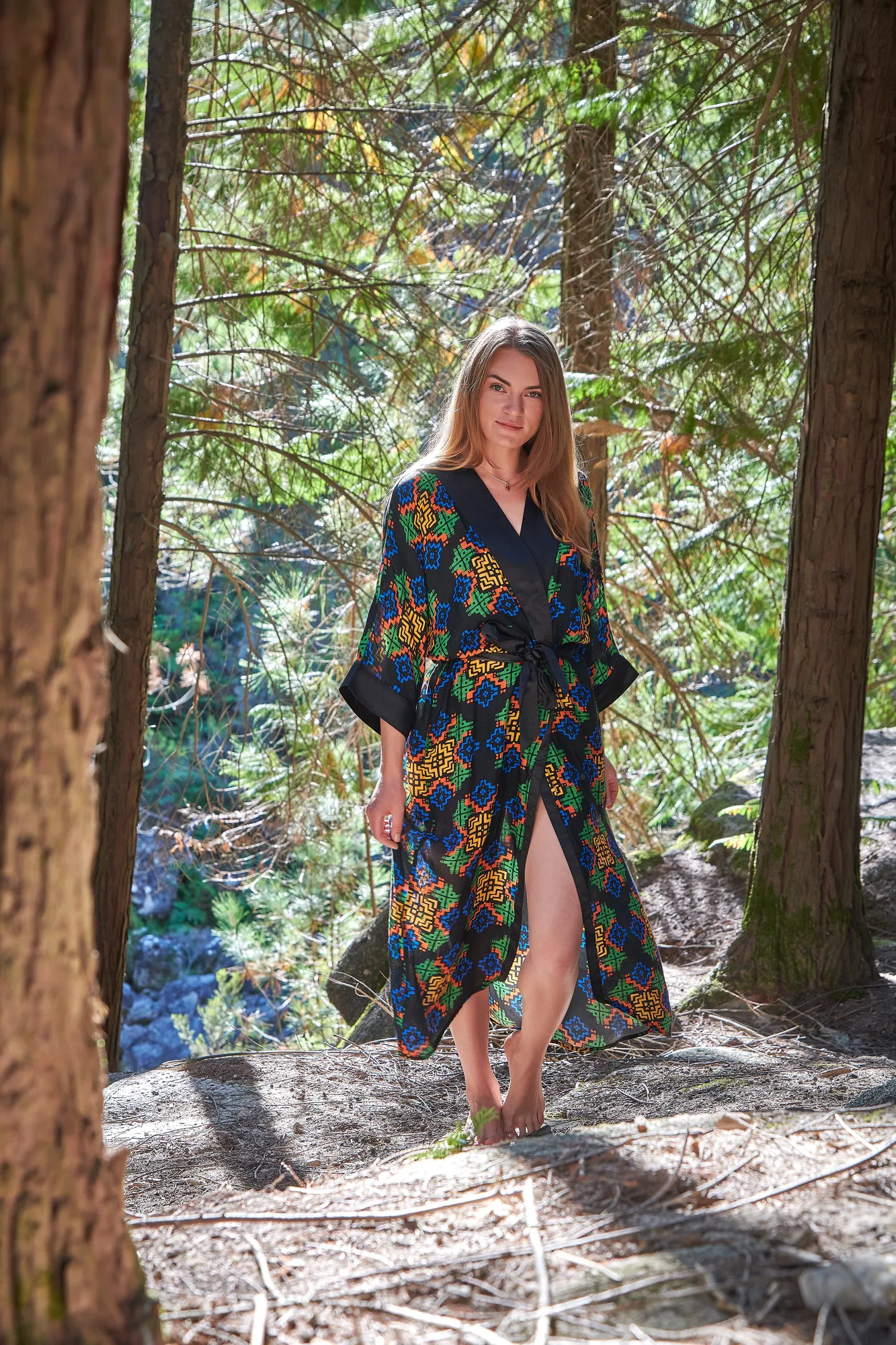
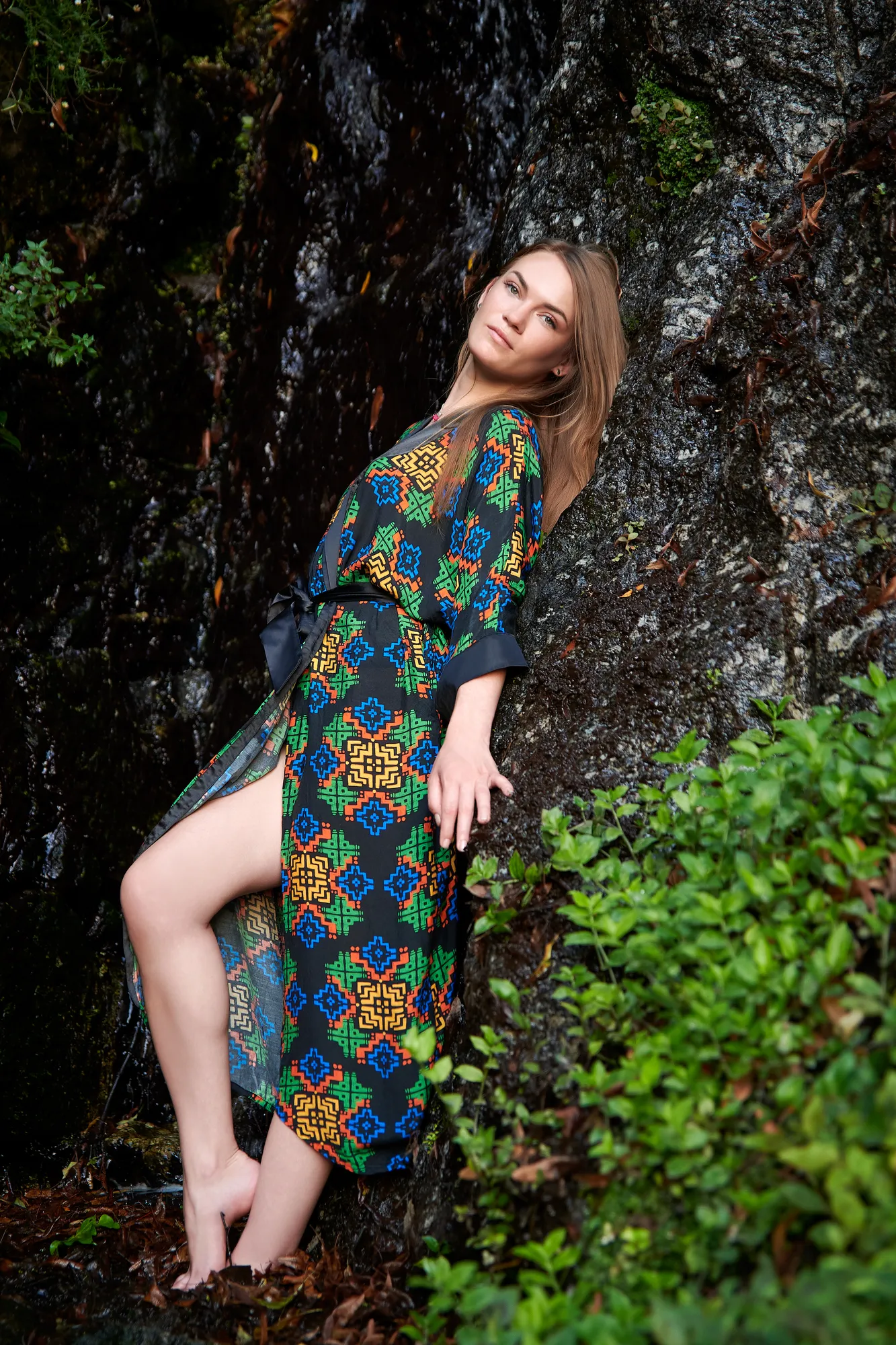
So the collection is named in these words, not decorated with them. Chakana is the bridge. Pacha Azul and Pacha Verde are the blue world and the green world — pacha, the world-moment. Selva Nina is the jungle and the fire: nina, fire, and my sister’s name. Ixchel Cipher reaches further north, to the Maya weaving goddess, because the thread is its own kind of bridge.
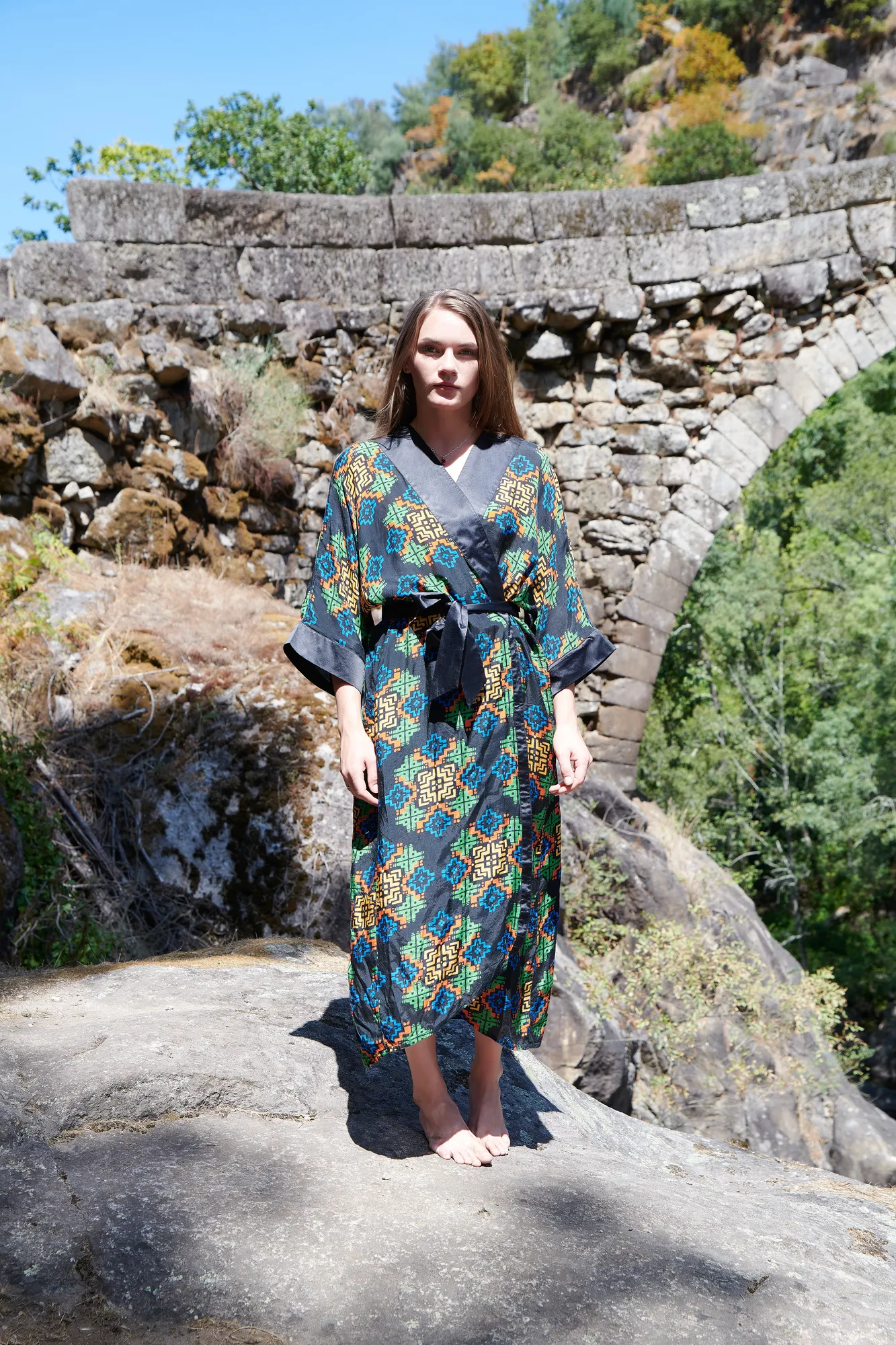
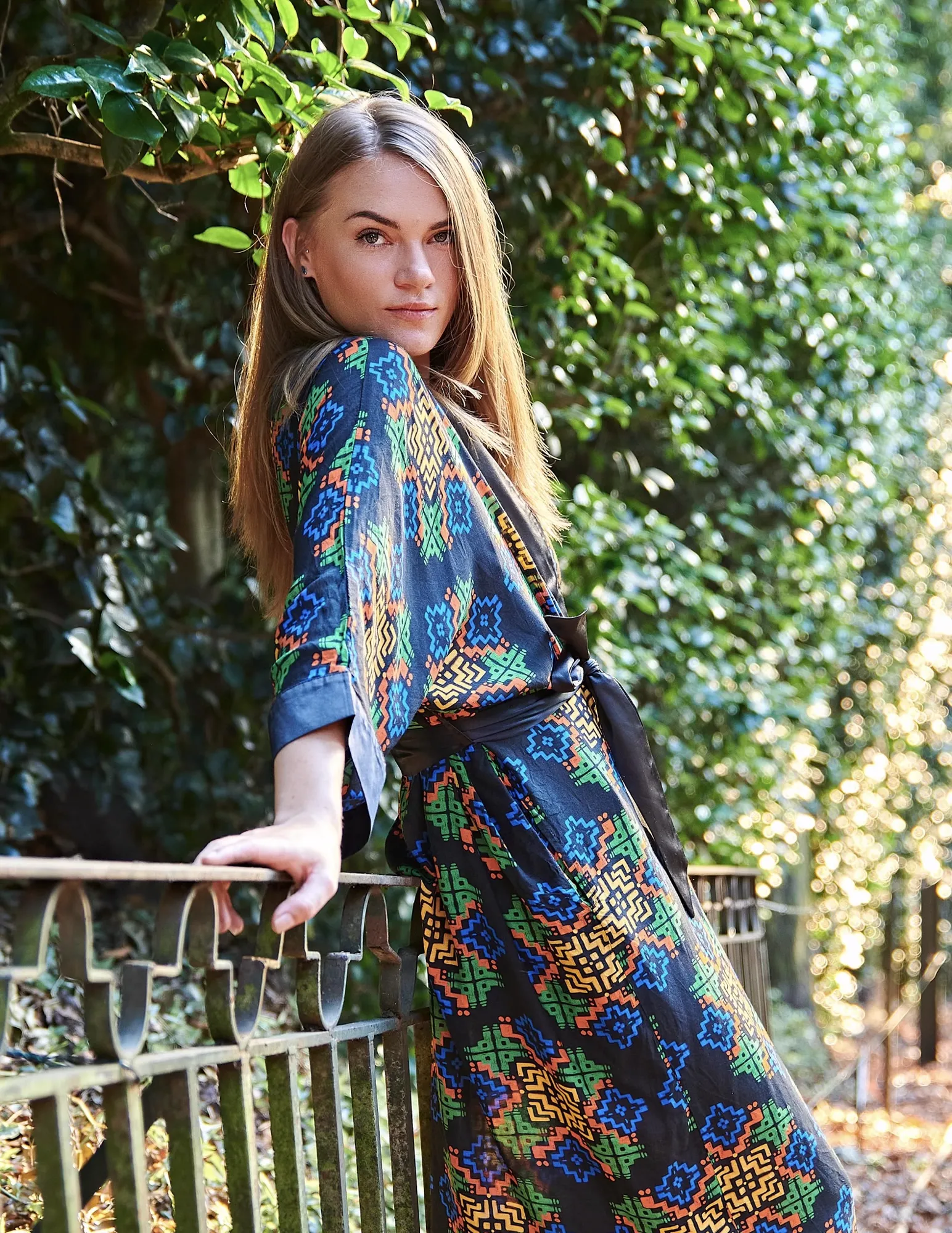
And there is one more reason it belongs on cloth rather than on a poster. If the stepped line really is the shape that weaving produces — the staircase you get when thread crosses thread — then putting the Chakana on a woven garment is not borrowing a symbol. It is returning it to where it came from.
Wearing it
This symbol is not mine to own. I grew up beside it; I did not invent it, and no brand did. The prints were made with artists from the places it comes from — Sarahi in Ecuador, Anki in Bolivia — paid and credited, which is the least that is owed.
If you wear one, wear it knowing what it is. It is light, but it should not be worn lightly. It is a protector of your energy, a soft hug, a spirit lifter. And it is a bridge that someone cut into stone four thousand years before any of us arrived.
Sources and inspiration
Where the written record is thin I have said so above. These are the published sources behind the archaeology and the language.
- - Chakana — Wikipedia
- - Pacha (Inca mythology) — Wikipedia
- - Pachamama — Wikipedia
- - Apu — Wikipedia
- - Mama Qucha — Wikipedia
- - Xicalcoliuhqui (the Mesoamerican stepped fret) — Wikipedia
- - Meander — Wikipedia
- - Tiwanaku — Wikipedia
- - Iñaq Uyu, House of the Chosen Women — Atlas Obscura
- - Isla de la Luna — Wikipedia